I use two decades of government expertise to solve big organizational challenges. I take the complexity out of service delivery to create measurable results for both staff and the public.
View Selected Work
"Good design is invisible—until it isn't. My job is to make it invisible."
I am a Strategic Lead and UX Researcher with over 20 years of experience navigating high-stakes federal operations and digital transformation. I specialize in bridging the gap between complex organizational challenges and the real humans navigating them.
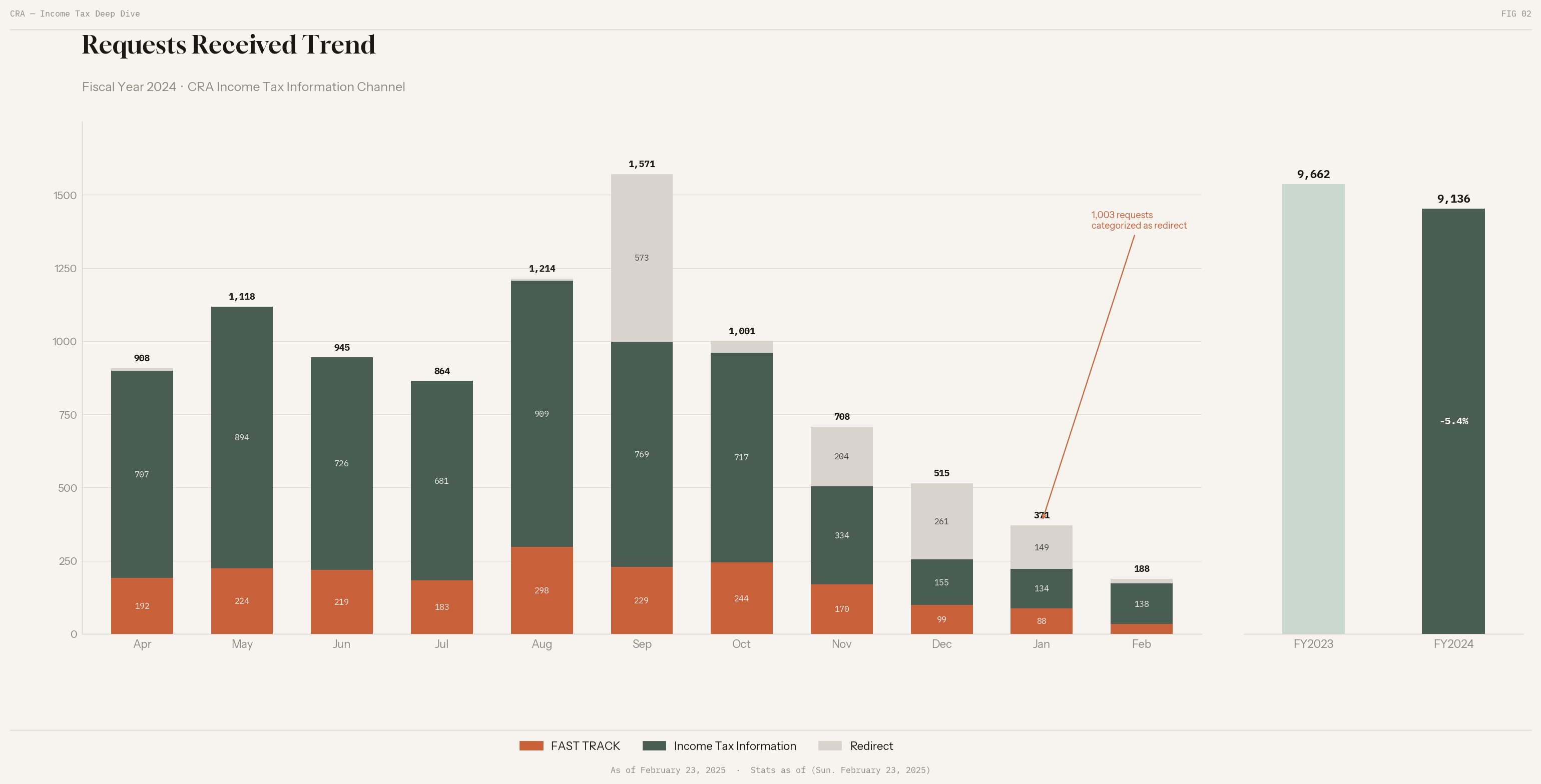
My work lives at the intersection of Operations and Experience. Whether I am redesigning federal ATIP processes to achieve a 24% reduction in manual volume or directing UX strategy for enterprise clients like Pacific Blue Cross and Finning, my goal is to drive measurable organizational change.
I leverage service blueprints, stakeholder alignment, and data-driven research to transform "red tape" into seamless digital workflows.
Bilingual (English/French) | International Facilitator (BMW Summer School 2019)
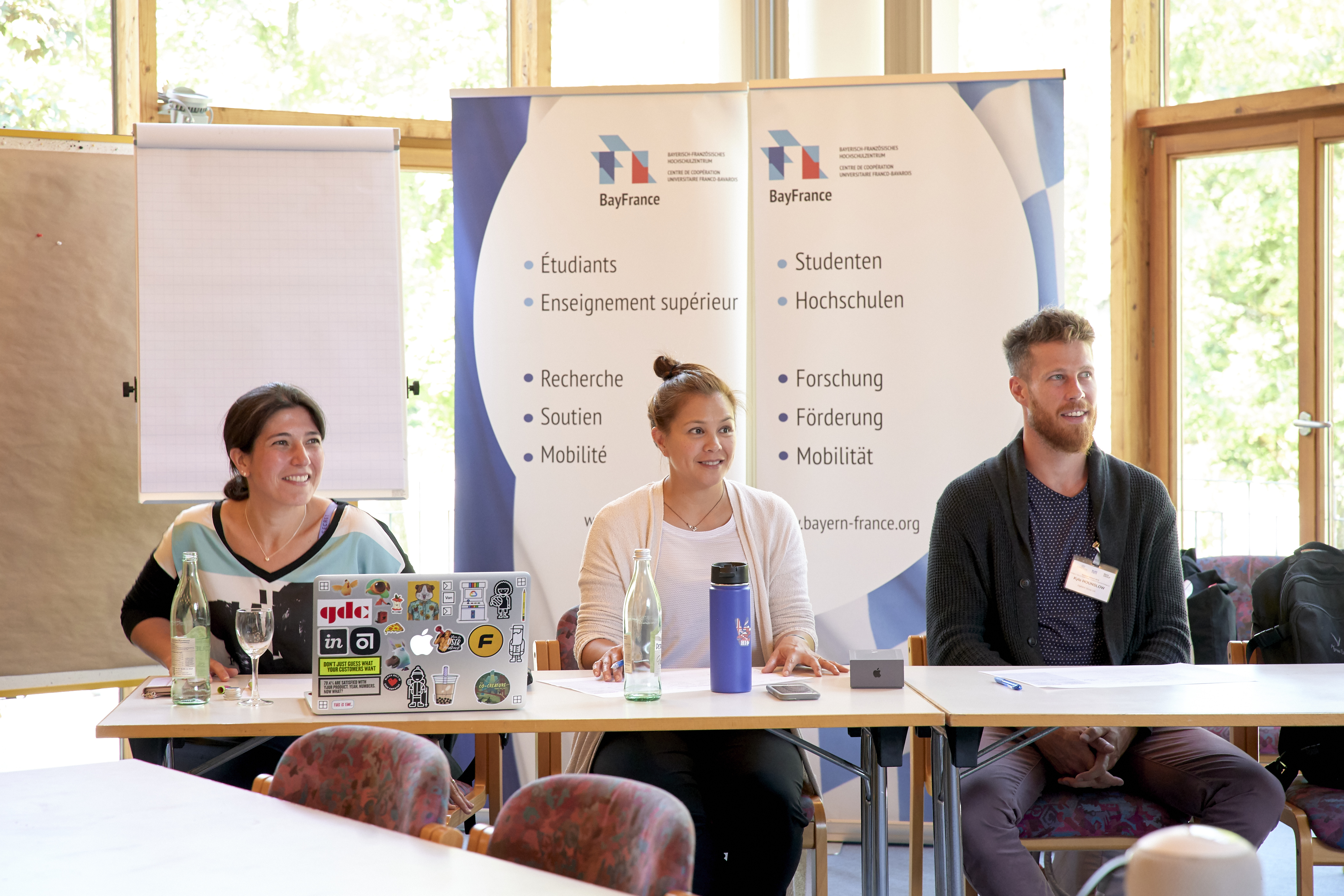
Selected as 1 of 3 international presenters at a high-profile BMW Group summer school jointly organized with EURECOM and Technische Universität München. Delivered a presentation on Frontiers in Machine Learning to a multinational audience of senior academics and industry leaders — demonstrating cross-disciplinary expertise spanning design, technology, and research.
Modernizing Federal Service Delivery through Design-Led Transformation
The CRA's Access to Information (ATIP) Directorate was facing an unsustainable surge in manual workloads. A high volume of requests was being funneled through formal legal channels for simple tax documents that should have been accessible via digital self-service.
However, a 3-year data limitation in the My Account portal meant users often couldn't find the historical records they needed, forcing them to file formal ATIP requests. Internally, a lack of clear redirection protocols meant intake staff had no "off-ramp" to guide these users back to digital channels, resulting in low-complexity files being processed with the same heavy administrative burden as sensitive legal inquiries.
I spearheaded the Fast Track Redirect Pilot, leading a Lean, cross-functional effort to modernize ATIP request handling. My approach focused on dismantling the systemic friction points that hindered operational efficiency and digital adoption:
Identified Behavioural & Systemic Barriers: Led research into why users bypassed digital self-service and why staff defaulted to formal processing. I identified the "3-year data gap" as the primary blocker for the public and established that existing triage protocols lacked the redirection mechanisms required to pivot low-complexity files toward self-service options, forcing staff into high-effort manual workflows.
Ecosystem Redesign: Orchestrated a new redirection workflow that synchronized internal staff behaviour with external user needs, supported by clearer digital messaging and refined intake procedures
Operational Integration & Feedback: Partnered with regional operations and governance teams to iterate on redirection messaging. I transformed frontline feedback into actionable system improvements, ensuring the "Fast Track" model remained compliant with the Privacy Act while improving speed
Executive Alignment: Produced service blueprints and research-driven roadmaps for senior leadership to secure buy-in for long-term digital transformation and permanent policy shifts
The pilot transformed the Directorate's operational efficiency and served as a proof-of-concept for design-thinking in government:
Operational Relief: Achieved a 24% volume reduction, significantly increasing analyst capacity for complex files
Policy Impact: Successfully advocated for and implemented the expansion of My Account coverage (3 → 10 years), removing the single largest barrier to user self-service
Institutional Recognition: Honored with the CRA-ATIP Valuable Visionary Award for innovation in service delivery and excellence in leadership
Validating Digital Transformation for the World's Largest Caterpillar Dealer
Finning International launched a digital platform to help customers monitor machine safety and performance. To ensure a successful global rollout, they needed to validate the platform's usability with real-world users and strengthen customer relationships by involving them in the development lifecycle. The goal was to evaluate six priority features and determine if they actually supported high-stakes decision-making in the field.
I served as the Lead UX Researcher for this 3-month Early Access Program, engaging with 16 customers across 5 Canadian branches. My focus was on deep discovery and usability validation to de-risk the product's future:
Discovery & Field Research: Conducted 7 site visits and job-shadowing sessions to see how customers interacted with heavy equipment in real-time. This uncovered environmental factors (like glare, gloves, or connectivity) that impacted digital tool usage
Usability Validation: Led 14 in-depth interviews and impression testing sessions. I used experience diaries and card-sorting to understand how customers prioritized data like fuel consumption vs. maintenance alerts
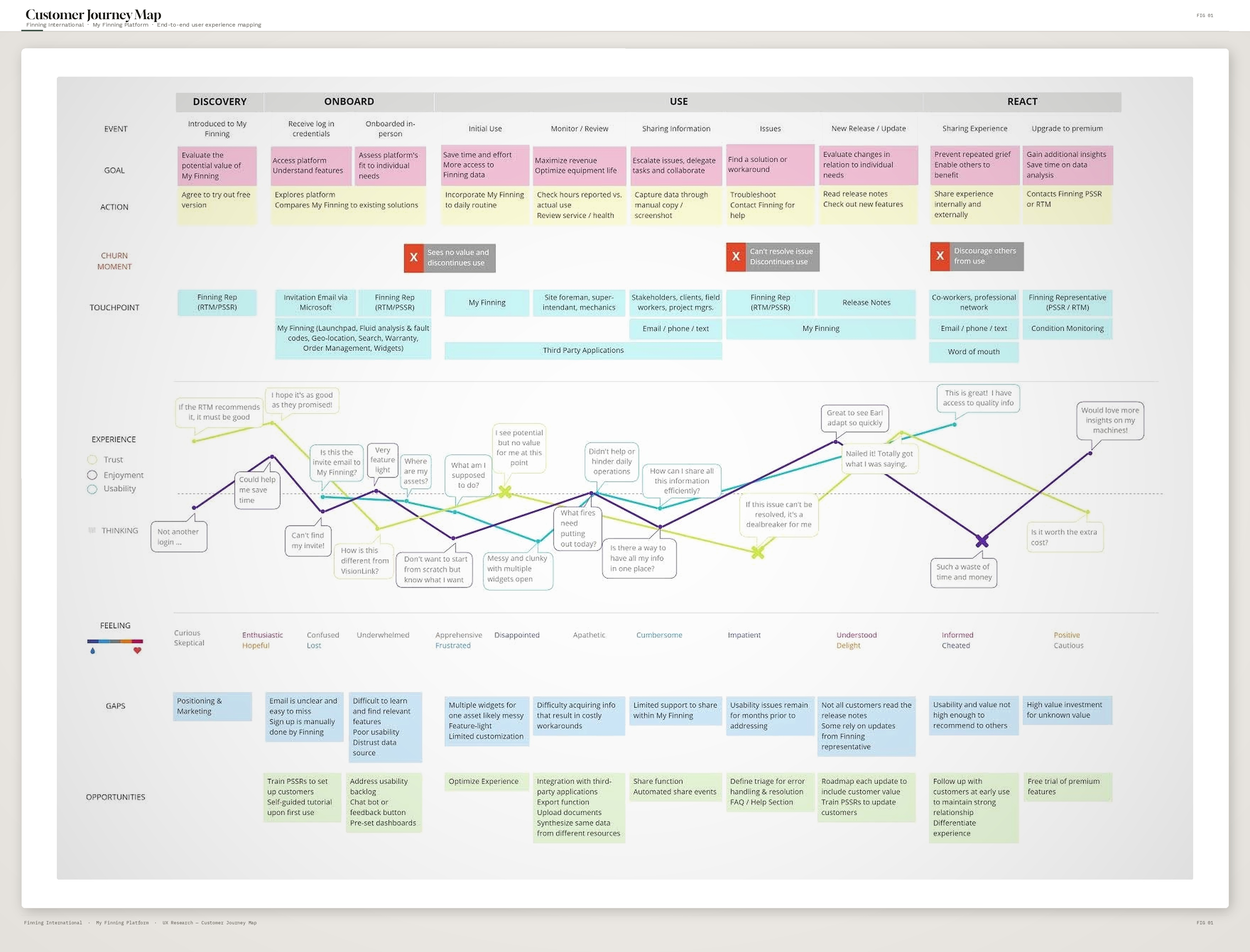
Customer Journey Mapping: Mapped the end-to-end user experience to identify "friction points" in the onboarding flow and feature navigation
Strategic Synthesis: Transformed raw research into a clear prioritization roadmap, providing the evidence needed for the design and engineering teams to iterate on the dashboard concepts
My research provided the "Green Light" and the "Fix List" required for a confident rollout:
Validated Value: The 81% UX score proved the platform met core customer needs
Marketing & Onboarding Alignment: My findings revealed that users struggled with certain terminology, leading to a complete rewrite of the marketing and onboarding materials
Risk Mitigation: By identifying 24 usability issues early, I saved the organization significant costs in "emergency" post-launch fixes
Cultural Shift: Established a "testing-first" culture within the project team, proving the ROI of research-led development
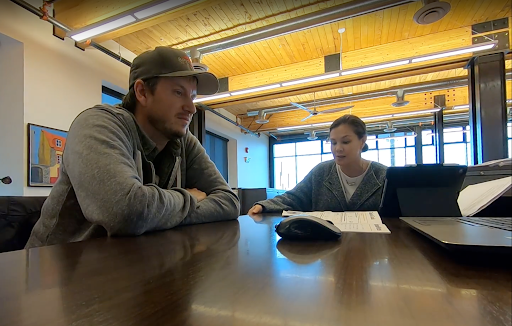
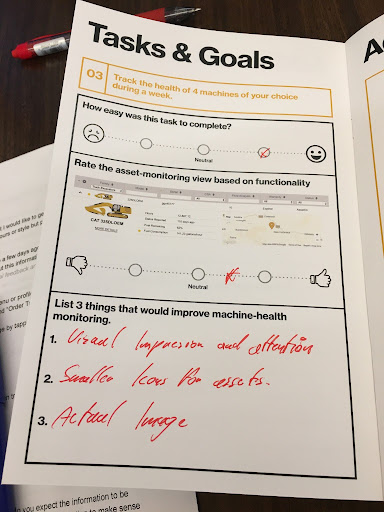
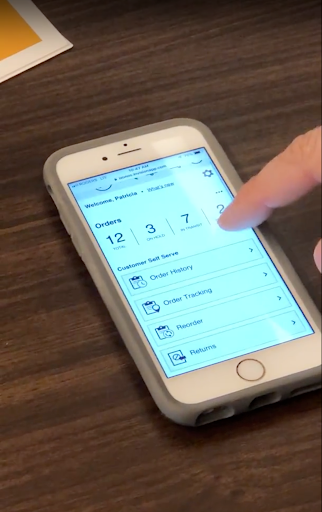
A look inside the research — from in-depth interviews and field site visits to structured task sessions with the live Finning platform.
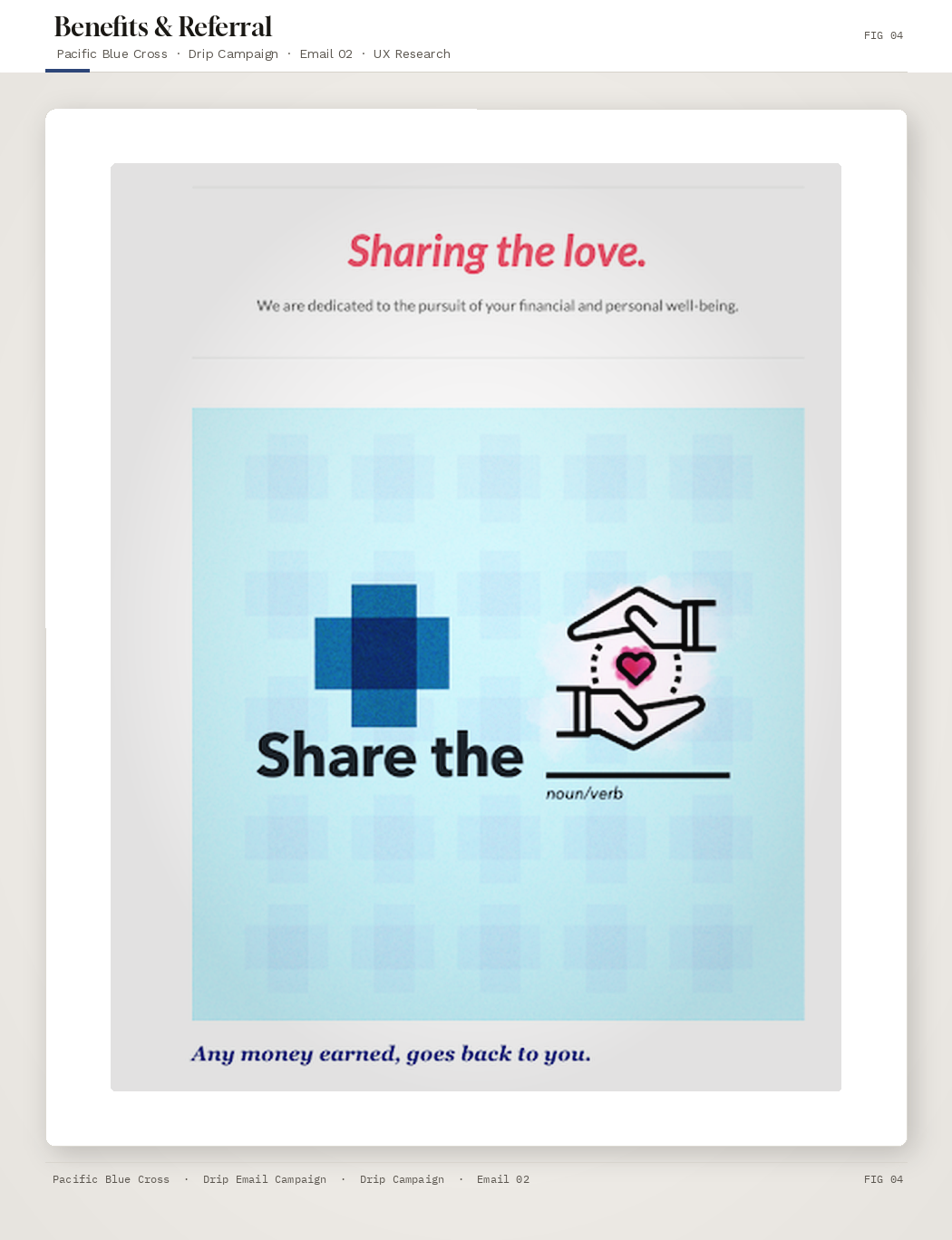
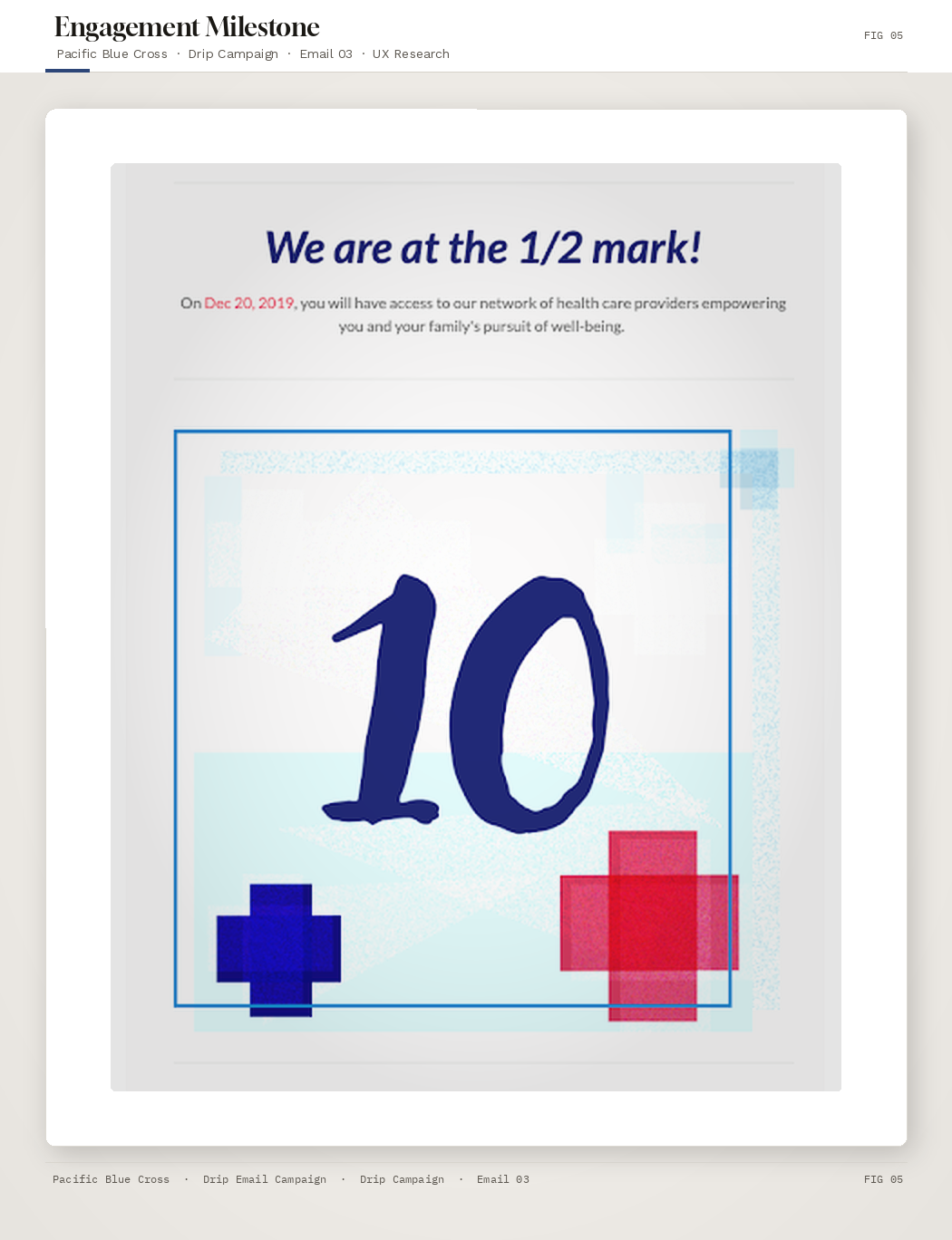
Bridging the gap between insurers, brokers, and members through research-driven design.
Pacific Blue Cross faced a major hurdle in their Group Business sector: a disconnected onboarding process. Because the distribution model involved multiple intermediaries (brokers and employers), the company had little direct contact with its actual members. This lack of transparency led to inconsistent data and manual processing errors.
As a core member of the Digitalist design team, I was responsible for the research foundation and concept development for this 12-week engagement:
Ecosystem Research: I conducted 40+ interviews across the entire value chain. I moved beyond "user needs" to document the specific business constraints of brokers and HR administrators
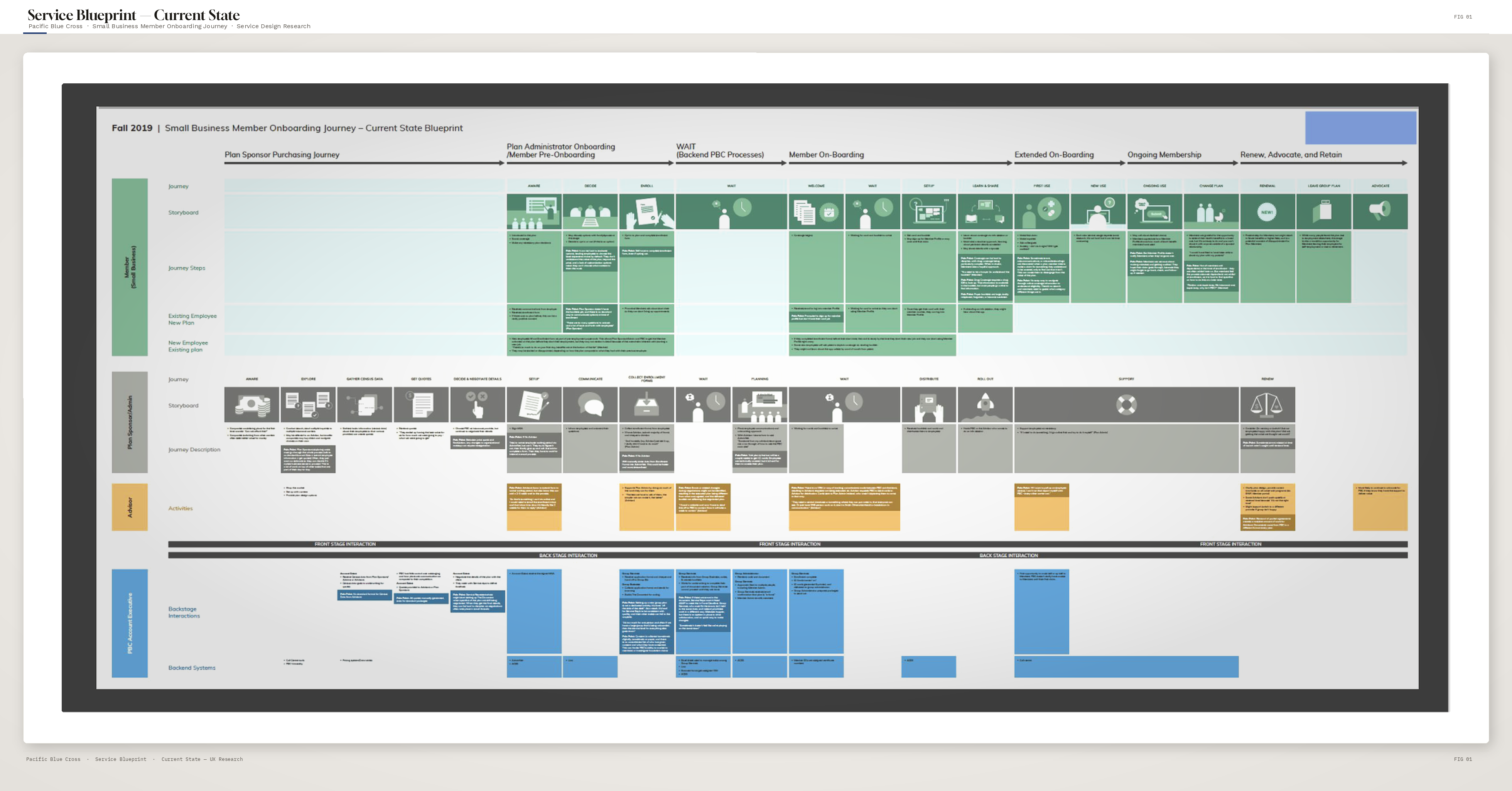
Workshop Facilitation: Supported the delivery of 7 stakeholder workshops, capturing critical insights to transition from siloed departmental views to a unified Service Blueprint
Advanced Persona Development: I authored 4 of the 6 research-backed personas, using psychographic segmentation (Learning Styles and Plan Literacy) to help PBC tailor their communications
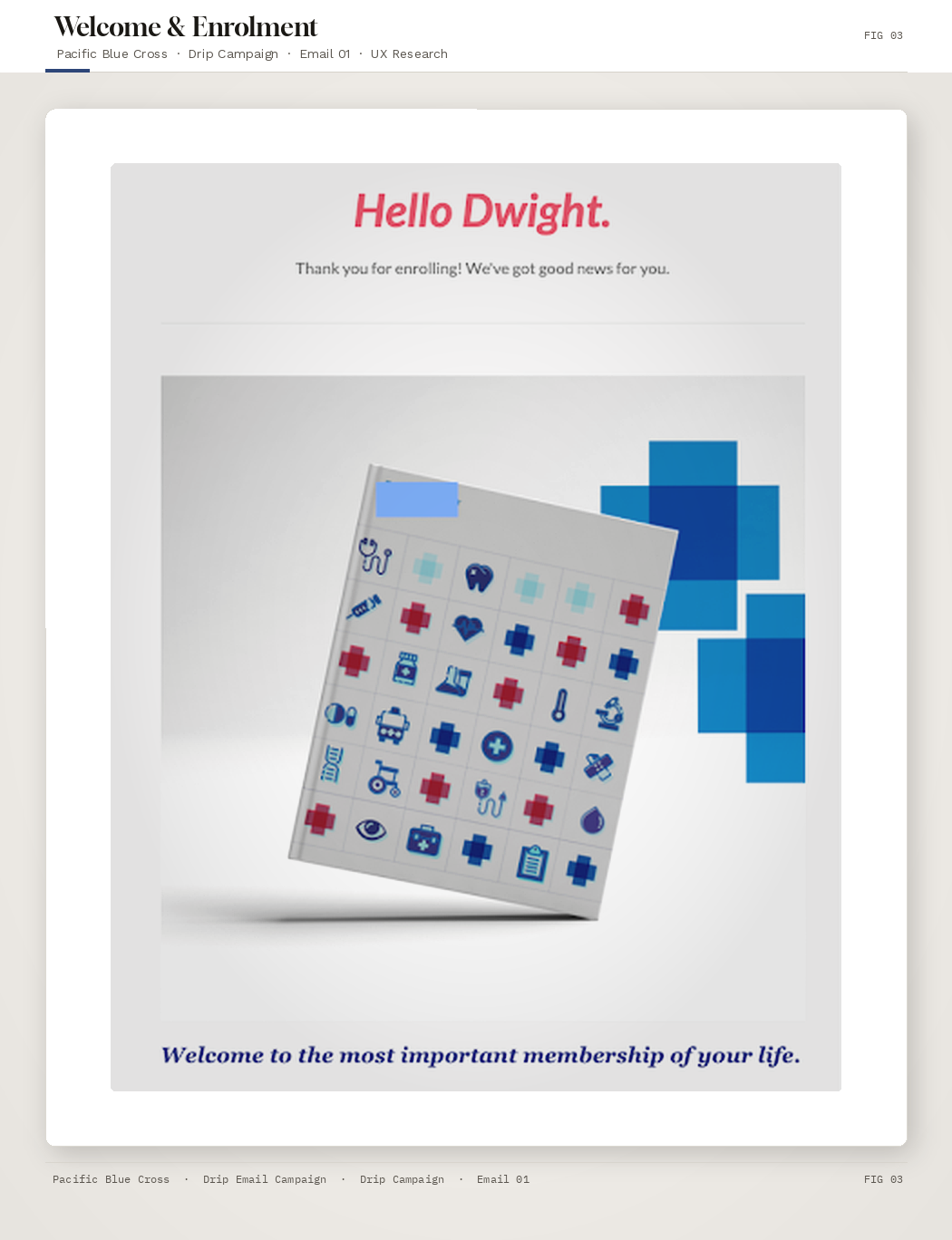
Concept Innovation: I designed the Interactive Enrollment Concept, a digital-first onboarding flow that moved consent to "Day 1." This was paired with an automated communication strategy to maintain engagement during the waiting period
The project provided Pacific Blue Cross with a clear roadmap for digital transformation:
Validated Solutions: We delivered 3 future-state concepts complete with business cases and KPIs
Operational Accuracy: The Interactive Enrollment concept I designed was specifically aimed at reducing technical language confusion and data entry errors
Strategic View: The final deliverables provided the PBC executive team with a comprehensive view of their ecosystem, influencing their long-term digital investment and member engagement strategy
Testing Usability and Content Clarity for New Member Features
As Coast Capital Savings evolved its digital products, the team needed to ensure that three new features — Card Control, Pre-Authorized Payments, and Contact Information — were intuitive and easy to use. Before moving to full development, the goal was to validate whether users could successfully complete key tasks, understand the terminology, and navigate the new interface without confusion.
I led a structured usability study to evaluate the performance of these net-new features. My work focused on gathering objective data through direct user observation:
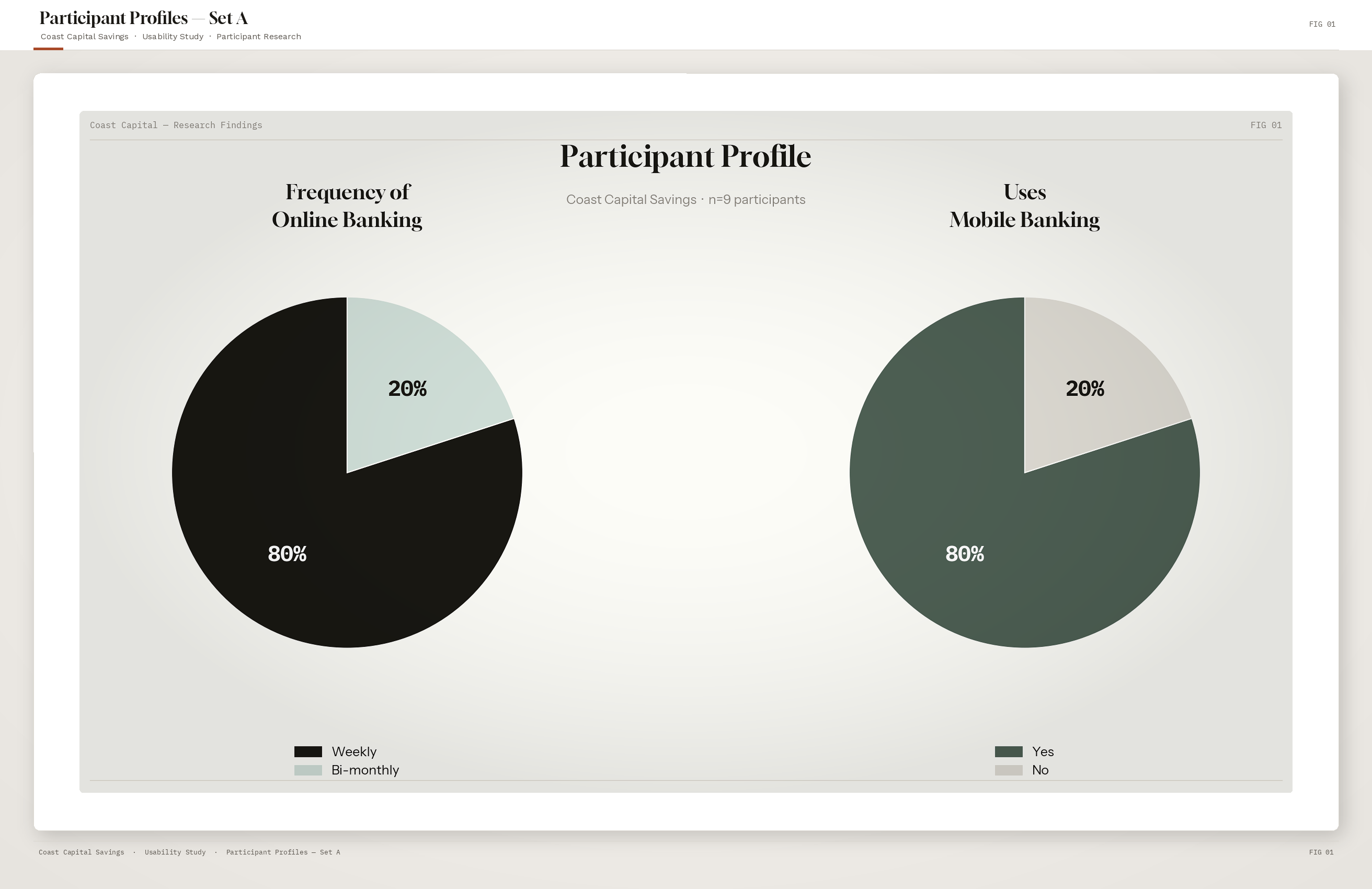
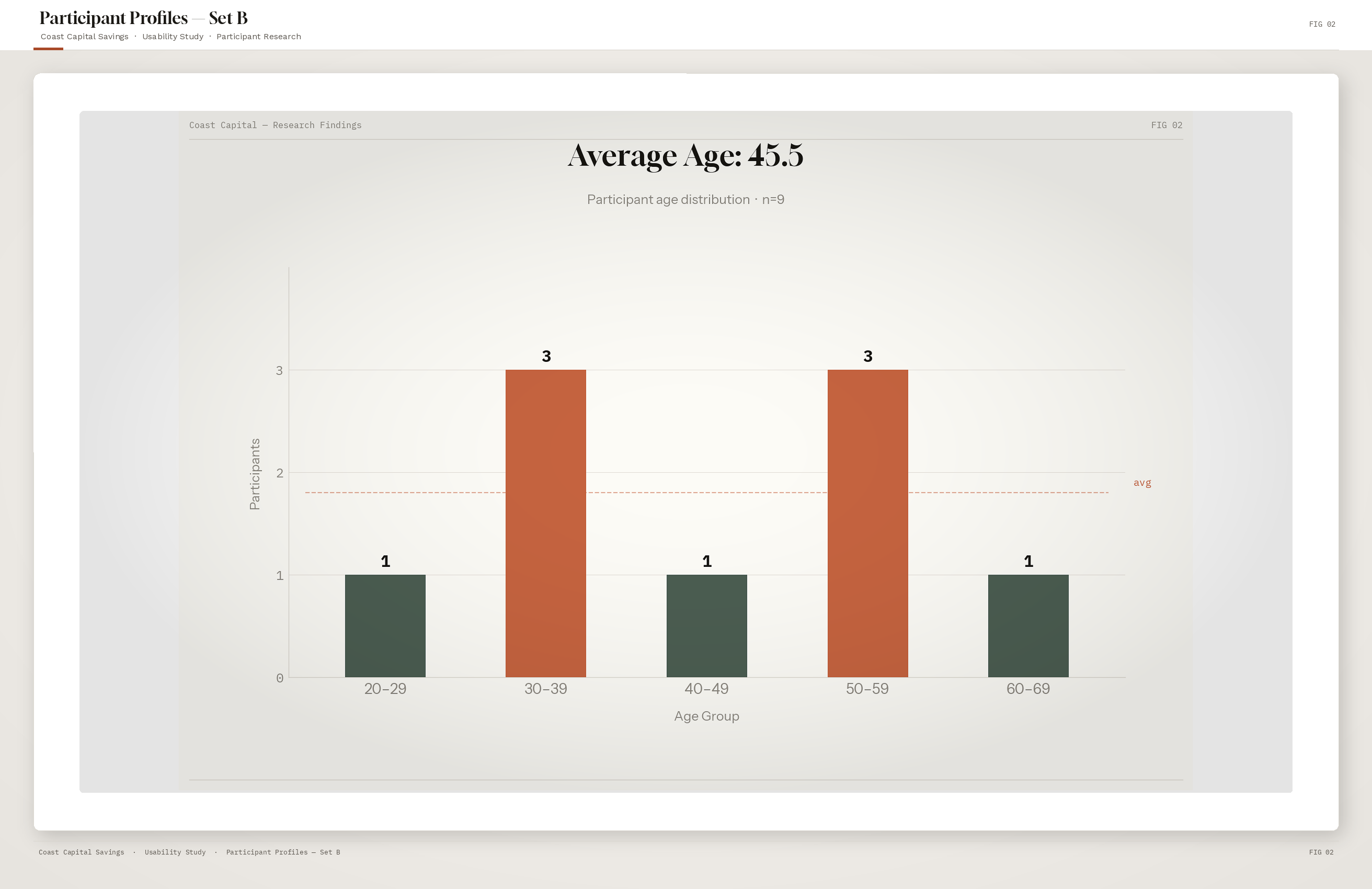
Study Design & Recruitment: I recruited 10 participants representing a wide age range (24–68) to reflect Coast Capital's diverse membership. I designed a 1-hour session format to observe real-world interactions
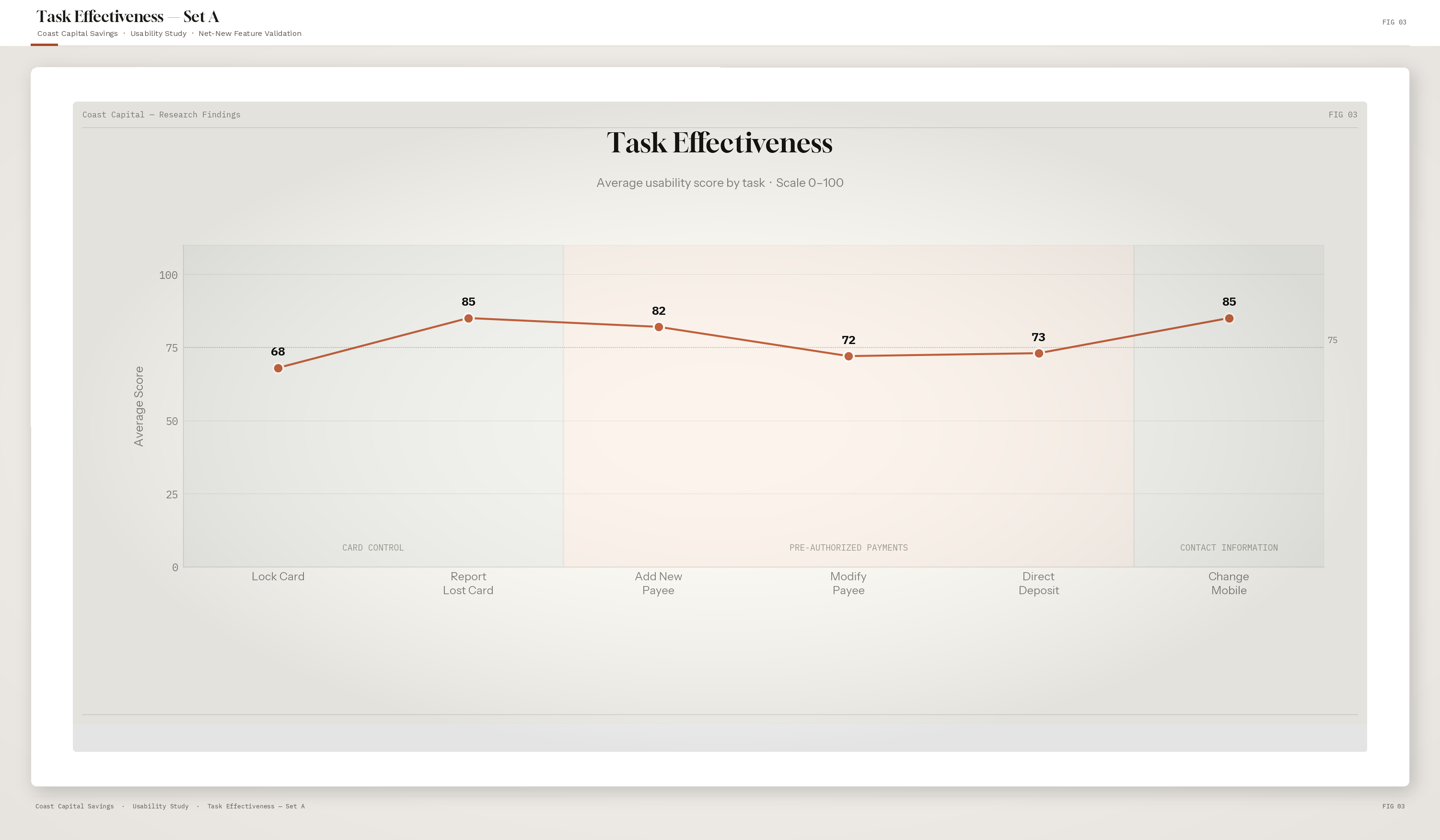
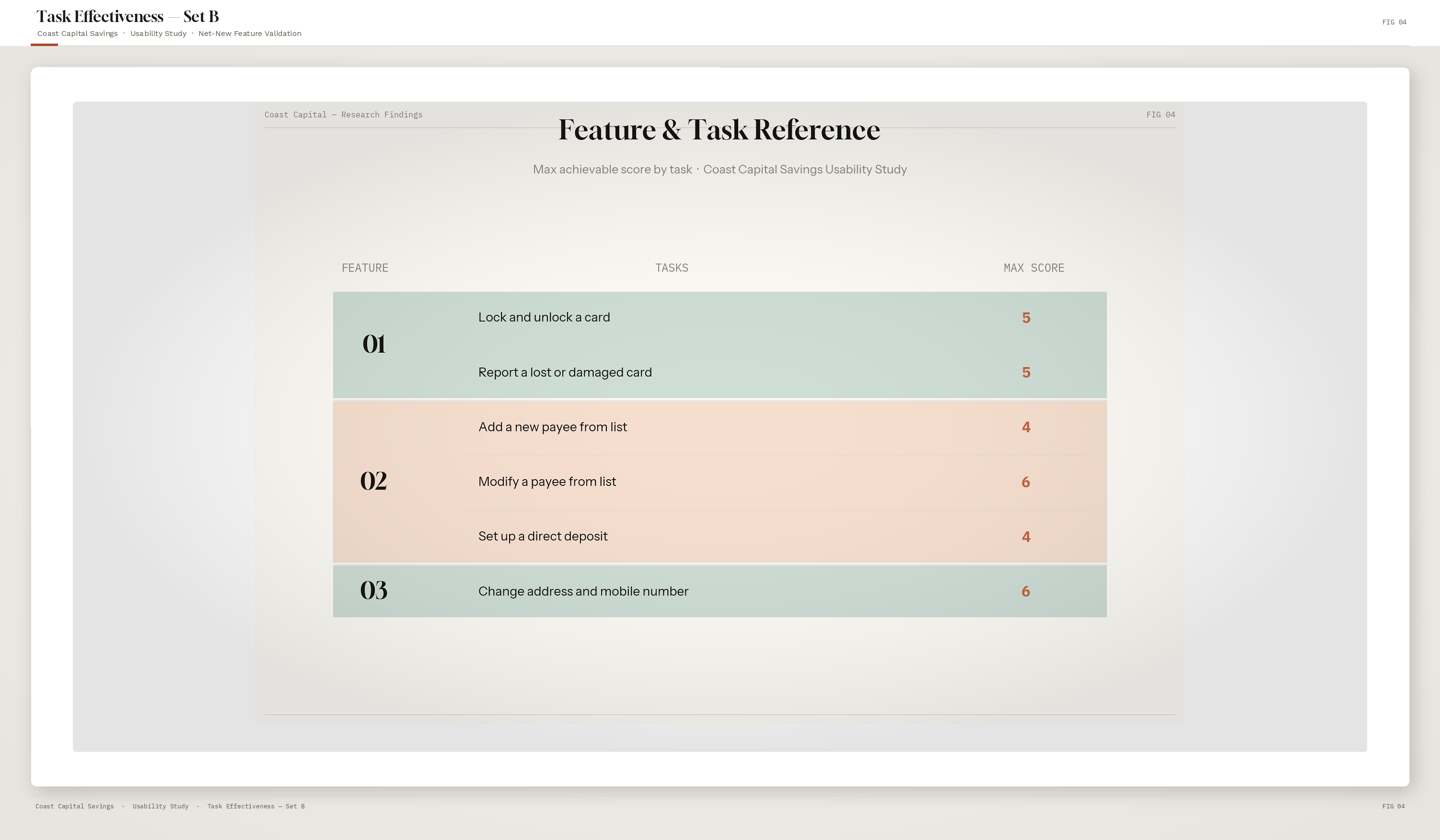
Task-Based Testing: I created specific scenarios for six critical tasks — such as reporting a lost card or adding a payee — measuring findability, completion, and how well users understood the results of their actions
Quantitative Scoring: I applied a structured scoring system to move beyond "opinions," providing the team with a measurable success rate for each feature
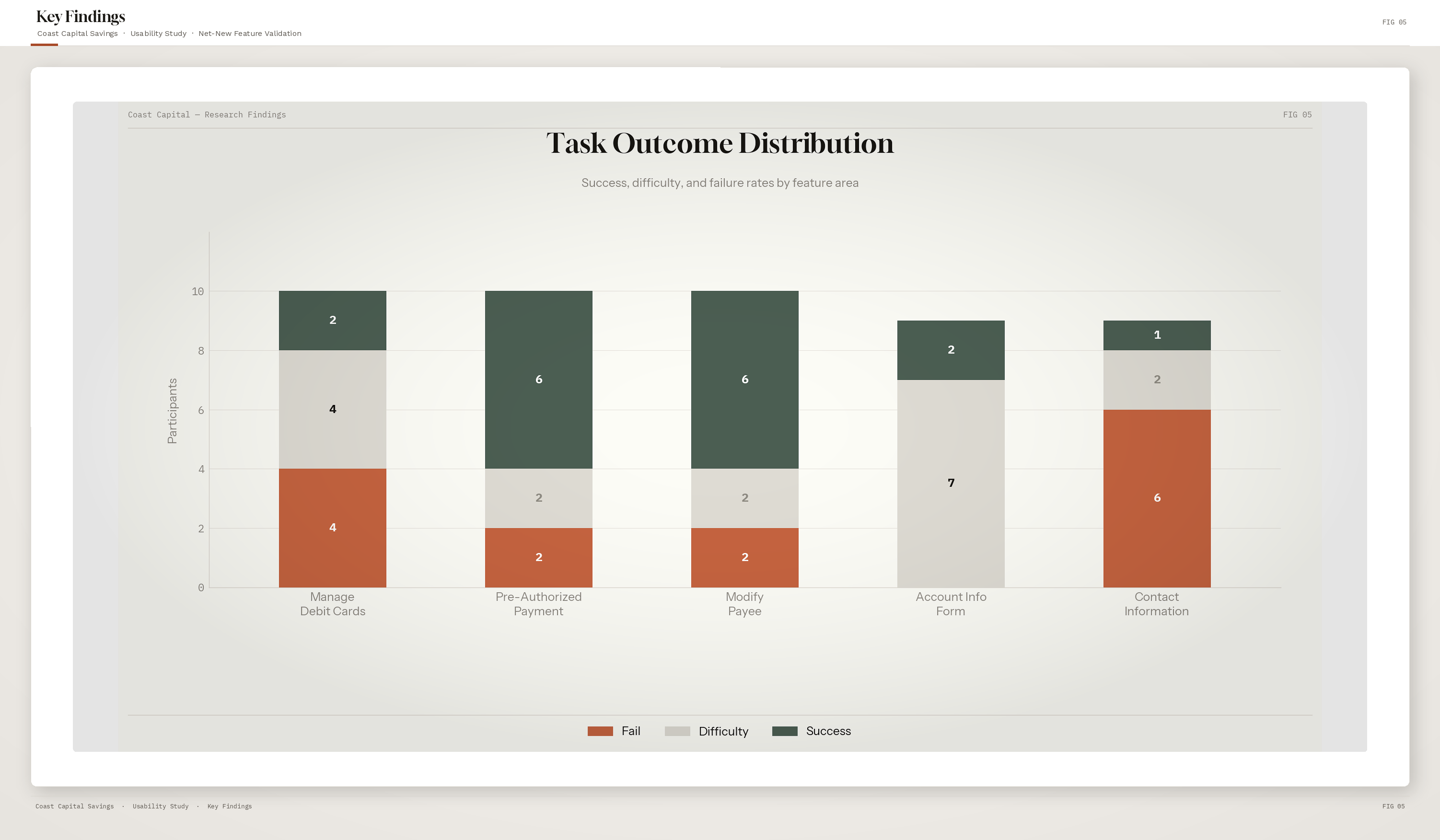
Findings Synthesis: I analyzed the sessions to identify 15 pain points and 6 specific terms (like those used in the payment screens) that caused users to hesitate or fail a task
My research provided the design and development teams with a clear "pre-launch" checklist:
Navigation Improvements: I identified that three features were hard to find in the current layout, leading to recommendations for clearer titles and better placement in the menu
Content Clarity: Uncovered terminology confusions (specifically in the Card Control and Payment sections), which led to a rewrite of the microcopy to ensure users felt confident in their actions
Prioritized Fixes: I delivered a summary of 3 priority recommendations that helped the team focus their efforts on the most critical usability issues before the features went live
The charts below show the quantitative study data — average task scores across all six tasks, effectiveness ratings per feature, and the overall pass/fail/difficulty breakdown that informed the final recommendations.
Identifying Systemic Inefficiencies in Complex Care Environments
MDH Network supports individuals with complex needs, but their internal operations were hindered by manual, disconnected systems. Scheduling, payroll, and patient documentation existed in silos, leading to data errors, delays, and significant staff burnout. The organization needed to move away from inconsistent manual practices toward a streamlined, integrated digital strategy.
As the primary researcher on this engagement, I was responsible for the "boots-on-the-ground" discovery that formed the foundation of the final strategy:
Contextual Inquiry & Site Visits: I completed 6 site visits, including field sites and group homes. By shadowing staff in their actual work environment, I was able to identify pain points that don't show up in a boardroom — like how physical layouts and "on-the-fly" care needs impacted tool usage
Multi-Level Stakeholder Interviews: I conducted 13+ interviews across the organization. My goal was to understand how information flowed (or stalled) between frontline supervisors, administrative staff, and the accounting department
Workshop Co-facilitation: I co-facilitated 3 strategic workshops, supporting the alignment of stakeholder goals and the co-creation of a new service vision. I was responsible for capturing and synthesizing real-time insights during these sessions
Workflow Analysis: I mapped current-state workflows to uncover the "root causes" of operational friction, specifically looking at how manual documentation created bottlenecks in payroll and scheduling
The insights I gathered provided the "evidence base" for MDH's digital transformation:
Root Cause Identification: We moved beyond surface-level symptoms to identify the systemic drivers of staff burnout and data errors
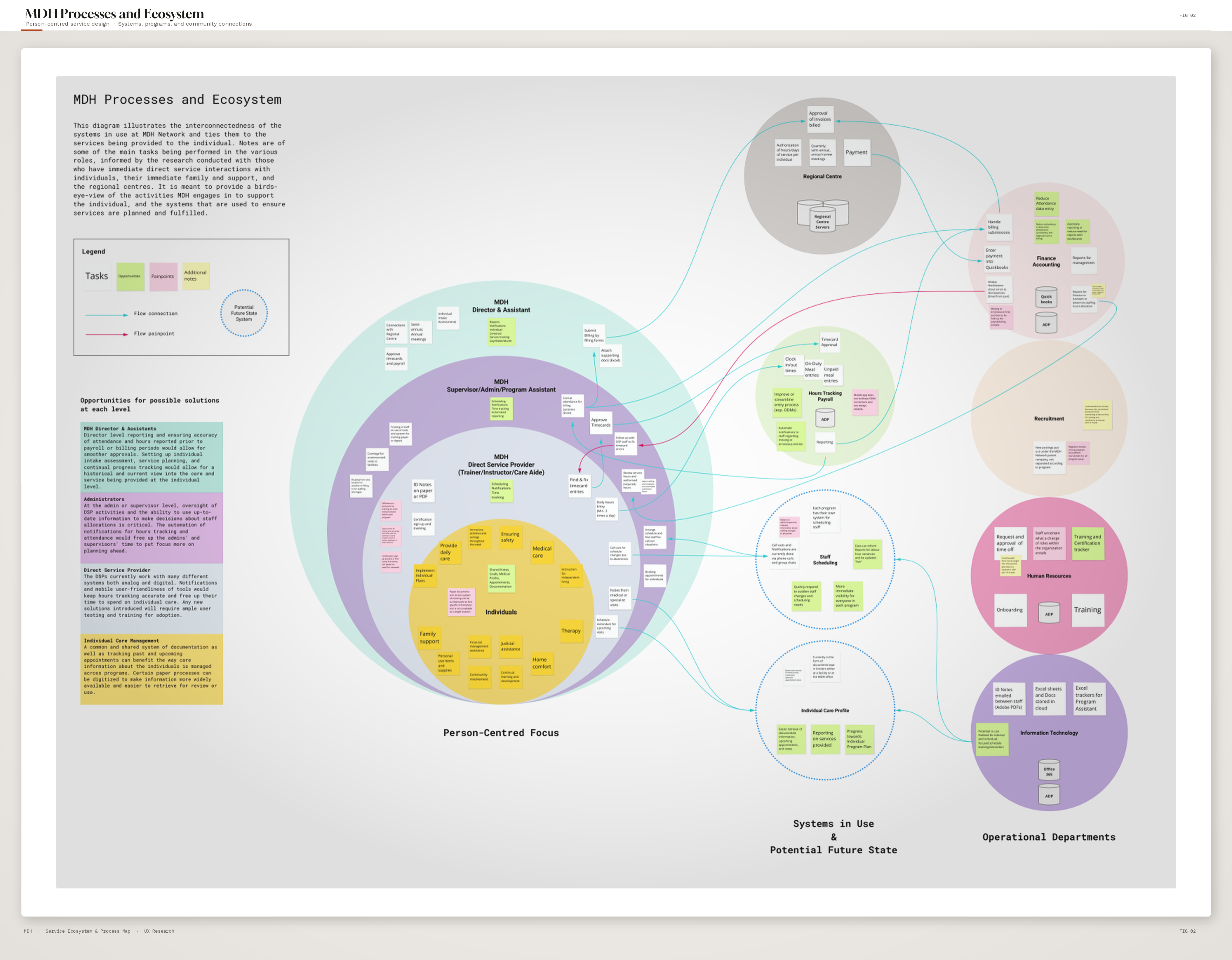
Strategic Ecosystem Input: My research directly informed the creation of a comprehensive ecosystem map, illustrating how departments and systems needed to integrate
Digital Transformation Roadmap: The findings paved the way for the development of a Financial Management Dashboard and a consolidated digital tool strategy, ensuring future investments solved the right operational problems
Facilitating Innovation at the Frontiers of Machine Learning
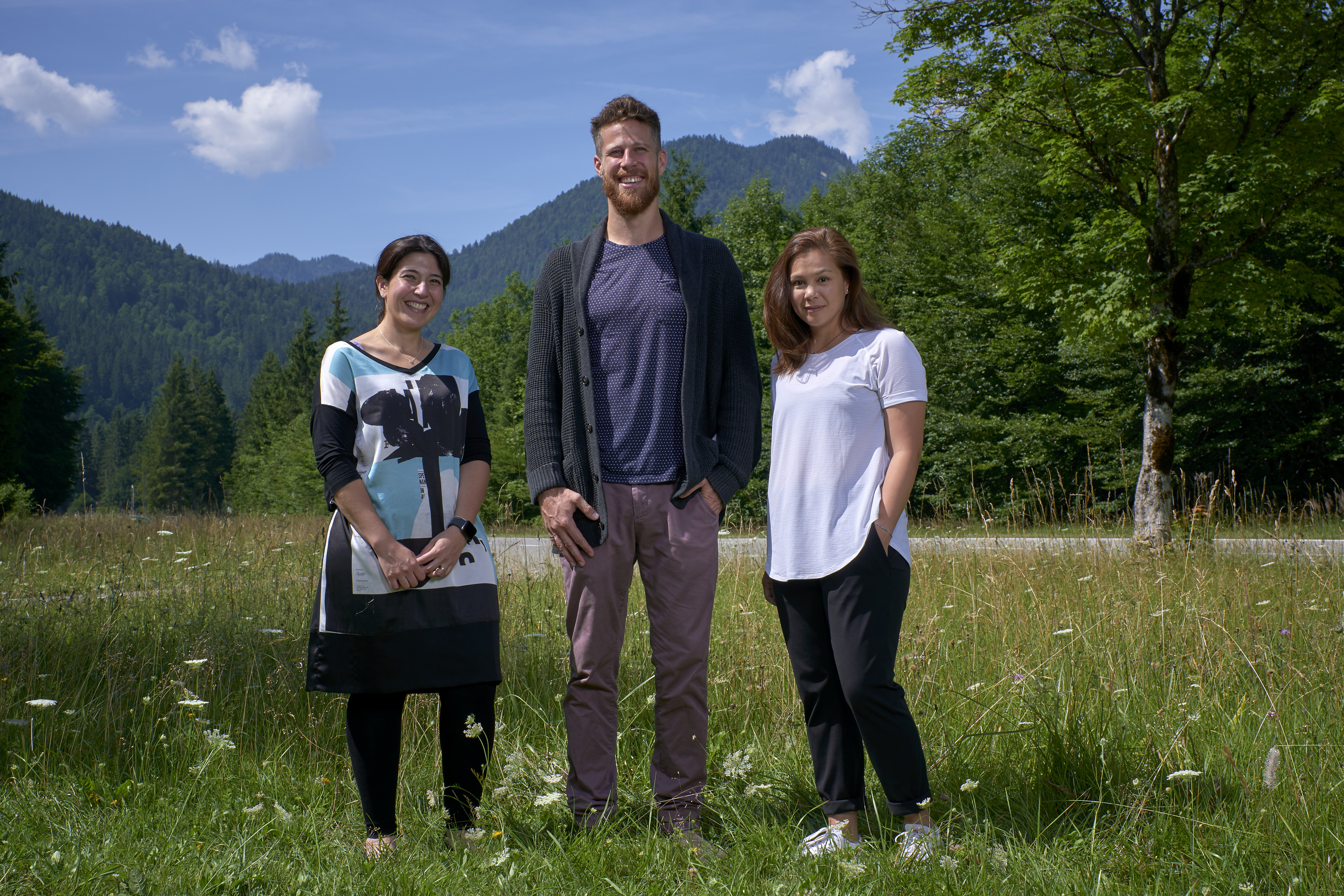
I was selected as part of a three-person facilitation team to present at the BMW Summer School, an elite international program for PhD students and junior scientists. The theme, "Frontiers in Machine Learning," required us to bridge the gap between high-level technical research and practical, human-centered service design.
I supported the design and delivery of The Lean Startup Machine, a curriculum that combined Lean Startup methodology with Service Design thinking. My role was to guide participants through the transition from "Machine Learning algorithms" to "User-Centered Products":
Sprint Delivery: Supported three intensive 3-hour hands-on sessions. I assisted teams in navigating the problem space, identifying target groups, and ideating around the "AI for Good" theme
Methodology Coaching: Helped participants apply Lean Startup principles — focusing on desirability, viability, and feasibility — to ensure their AI concepts addressed real-world needs aligned with the UN Sustainable Development Goals
Prototyping & Pitch Prep: Worked directly with technical teams during the sketching and voting phases, helping them translate complex AI logic into clear promotional messaging and pitch presentations
International Coordination: Collaborated with organizers from BMW Group and European universities to ensure a seamless experience for a diverse, high-level audience
The program successfully demonstrated how design thinking can accelerate scientific innovation:
Rapid Concept Development: Facilitated the journey for multiple teams to ideate, prototype, and pitch AI solutions addressing global challenges
Cross-Disciplinary Impact: Proved the value of Lean Startup methods in an international research context, helping technical scientists think like service designers
Personal Growth: Gained invaluable experience in international stakeholder management and high-pressure workshop delivery
From service blueprints to operational strategy, I help organizations find the path forward. If you have a challenge that needs a mix of deep institutional wisdom and modern design thinking, let's talk.
eileen.dima@gmail.com 604.644.1797